Most cars spend the majority of their lives doing absolutely nothing.
You drive to work. Park for eight hours. Drive home. Then park again overnight.
For decades, that has simply been part of owning a car.
Tesla wants to change that.
With Cybercab and its Robotaxi network, Tesla is pursuing a future where a vehicle may not just cost you money—it could potentially generate income when you are not using it.
And that idea may be far more important than the Cybercab itself.
What Is Tesla Cybercab?
Cybercab is Tesla’s purpose-built autonomous Robotaxi.
Unlike a traditional Tesla, Cybercab is designed around autonomous transportation from the beginning. It is a two-seat vehicle with butterfly-style doors, a large touchscreen and, most importantly, no steering wheel.
As of September 2026, Tesla says Cybercab rides are available in limited areas of Austin, Texas. Tesla’s broader Robotaxi service is also operating with Model Y vehicles in several U.S. cities.
Tesla also says people interested in purchasing an individual Cybercab or a fleet of Cybercabs for commercial purposes can submit an inquiry to the company.
That last point is especially interesting.
Because it begins to move Cybercab from simply being “Tesla’s taxi” toward something that could potentially become a business asset.
Imagine This Future
Here is where Tesla’s vision gets fascinating.
Imagine owning an autonomous Tesla.
7:30 AM: Your car takes you to work.
8:00 AM – 5:00 PM: Instead of sitting in a parking lot, the vehicle enters Tesla’s Robotaxi network and carries passengers.
5:30 PM: The car leaves the network and returns to your office to pick you up.
Evening: If you do not need it, the vehicle could potentially go back to work.
In other words:
You use the car when you need it. The car works when you don’t.
This exact consumer experience is not commercially available today, and Tesla has not confirmed that Cybercab owners will simply be able to switch between personal use and Robotaxi service.
But the basic concept is not new.
Back in Tesla’s 2016 Master Plan, Part Deux, Elon Musk described a future where Tesla owners could add their vehicles to a shared fleet through the Tesla app and generate income while they were at work or on vacation.
Ten years later, pieces of that idea are finally beginning to appear in the real world.
From Depreciating Asset to Income-Producing Asset
This could fundamentally change the economics of car ownership.
Today, when you buy a $40,000 or $50,000 car, you normally expect:
Depreciation. Insurance. Maintenance. Charging or fuel costs.
The vehicle is almost always an expense.
But imagine if that same vehicle could produce revenue for several hours every day.
Here is a purely hypothetical example.
Robotaxi Operation
Hypothetical Net Income*
3 hours/day
$750/month
6 hours/day
$1,500/month
10 hours/day
$2,500/month
Example assumes $10 per operating hour for 25 days per month. This is only an illustration—not a Tesla forecast or estimate. Actual economics would depend on fares, utilization, Tesla’s platform fee, insurance, charging, maintenance, cleaning, depreciation, taxes and many other factors.
The numbers are not the important part yet.
The important question is:
What happens when a car stops being something you only consume and becomes something capable of producing revenue?
That could completely change how people calculate the true cost of owning a vehicle.
But There Are Some Big Problems to Solve
This future is exciting, but it is not guaranteed.
Autonomous vehicles introduce a completely different set of questions.
Who pays when an autonomous Robotaxi crashes?
How much will commercial insurance cost?
Who cleans the vehicle between passengers?
Who handles charging?
How quickly will a heavily used Robotaxi depreciate?
How much of each fare will Tesla keep?
And most importantly, will regulators allow individually owned autonomous vehicles to operate commercially?
These questions could determine whether owning a Robotaxi becomes a genuinely profitable business or simply an interesting technological experiment.
Tesla itself acknowledges that the success of Robotaxi will depend on factors including consumer adoption, autonomous-driving acceptance and competition.
Why Cybercab Matters More Than Just Another Tesla
I don’t think the most interesting thing about Cybercab is its design.
It isn’t even the fact that it has no steering wheel.
The real story is the business model behind the vehicle.
Tesla has traditionally made money by selling cars.
But autonomous vehicles potentially create another model:
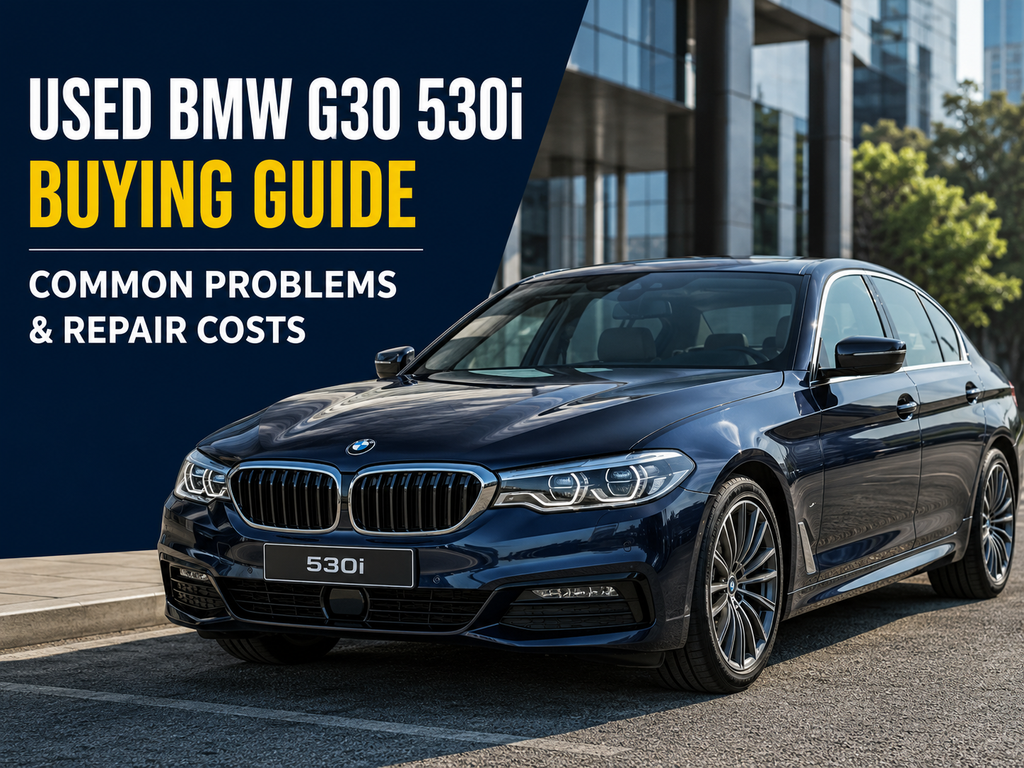
The BMW G30 530i is one of the most appealing used luxury sedans on the market.
It offers excellent ride comfort, good fuel economy, a premium interior, and enough performance for everyday driving without the higher running costs of a six-cylinder 540i.
But as these cars get older, one question becomes increasingly important:
Is a used BMW 530i still a smart buy, or will maintenance and repair costs become too expensive?
This guide focuses mainly on the 2017–2023 BMW G30 530i and 530i xDrive sold in the U.S.
We’ll look at reliability, common problem areas, realistic repair costs, and the things you should inspect before buying one.
Is the BMW G30 530i Reliable?
Overall, the G30 530i is one of the more sensible modern BMWs to own.
The 530i uses BMW’s 2.0-liter turbocharged B48 four-cylinder engine, paired with the ZF 8-speed automatic transmission.
The combination delivers a good balance of performance, efficiency, and durability.
The B48 is generally considered a significant improvement over some earlier BMW turbo four-cylinder engines.
That does not mean the 530i is maintenance-free.
As mileage increases, several areas deserve close attention:
Cooling system components
Oil leaks
Engine mounts
Suspension bushings
Brakes and tires
Electronic systems
Previous maintenance history
The condition of the individual car matters more than simply choosing the lowest-mileage example.
A well-maintained 70,000-mile 530i can easily be a better purchase than a neglected 40,000-mile car.
1. Cooling System Problems
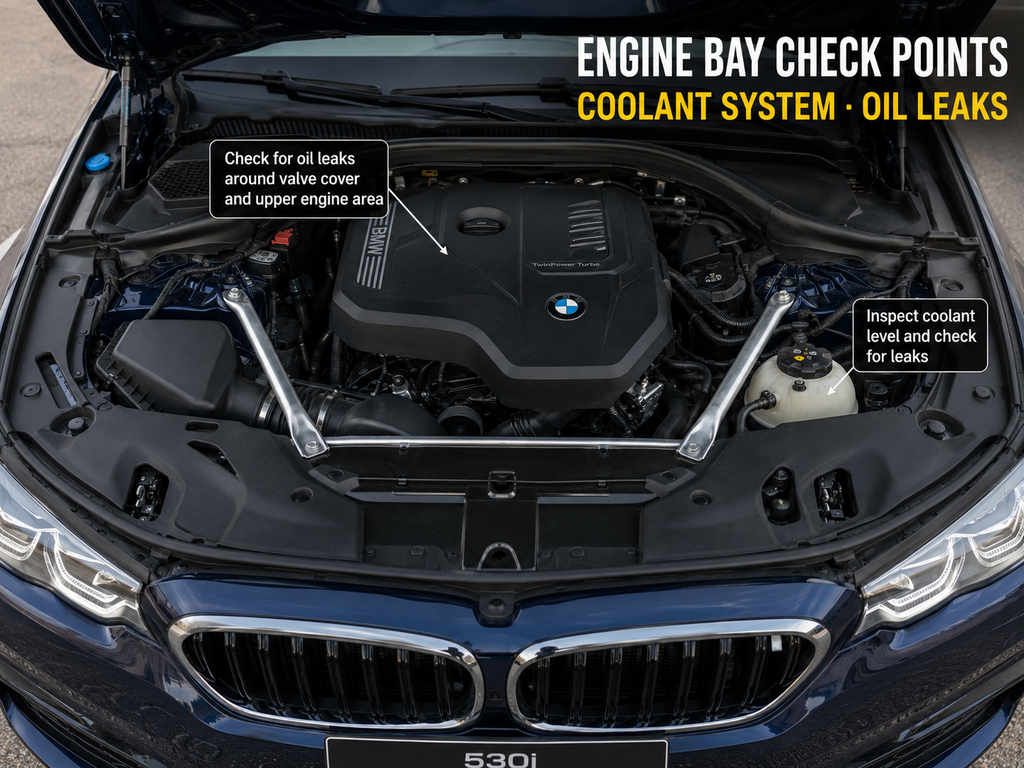
One of the first areas to inspect on a used G30 530i is the cooling system.
BMW cooling systems use several plastic hoses, fittings, reservoirs, and electronically controlled components.
As the car ages, small coolant leaks can develop.
Warning signs include:
Low coolant warning
Sweet coolant smell
Dried coolant residue in the engine bay
Coolant level slowly dropping
Engine temperature warnings
Visible leaks under the vehicle
Do not ignore a small coolant leak.
A minor hose or fitting problem can eventually result in overheating if the coolant level becomes too low.
Water Pump and Thermostat
The water pump and thermostat are also important components to inspect as mileage increases.
Typical U.S. repair estimates can be significant.
A BMW 530i water pump replacement can cost roughly $800–$1,050, while thermostat replacement on some G30 model years can approach or exceed $1,100.
Actual prices vary depending on model year, labor rates, location, and whether additional cooling-system components are replaced at the same time.
What to check before buying
Open the hood when the engine is cold.
Look around the coolant reservoir, hoses, and connections for:
White or colored residue
Damp areas
Recently cleaned sections
Low coolant level
If possible, have the cooling system pressure-tested during a pre-purchase inspection.
2. Oil Leaks and Valve Cover Gasket
BMW engines are known for developing oil leaks as they age, and the B48 is no exception.
One area worth inspecting is the valve cover and valve cover gasket.
Small oil leaks may not immediately affect the way the car drives, but they can become more expensive over time.
Possible symptoms
Burning oil smell
Oil residue around the top of the engine
Small drops of oil underneath the car
Smoke or odor after driving
Gradual engine oil loss
On a G30 530i, valve cover gasket replacement can easily run into several hundred dollars and, depending on model year and labor rates, may exceed $1,000.
The important point is not that every 530i will develop an oil leak.
The important point is to know whether the car you are buying already has one.
3. Engine Mount Wear
The BMW 530i should feel smooth and refined at idle.
If you feel excessive vibration through the steering wheel, seat, or cabin while stopped in Drive, worn engine mounts may be a possibility.
Engine mounts absorb vibration from the engine and isolate it from the passenger compartment.
As they wear, the car may still drive normally, but the luxury-car refinement begins to disappear.
Common symptoms
Noticeable vibration at idle
More vibration in Drive than Neutral
Slight shaking when starting or stopping the engine
Rough feeling through the steering wheel or seats
Depending on model year, U.S. repair estimates for engine mount replacement can range from roughly $400 to $800 or more.
This is not usually a reason to reject an otherwise good car.
However, it should be considered when negotiating the purchase price.
4. Front Suspension Bushings and Control Arms
One reason the G30 5 Series feels so good on the highway is its suspension tuning.
But suspension components are wear items.
On higher-mileage cars, bushings and control arms can eventually develop play.
During a test drive, listen for:
Clunking over small bumps
Knocking noises
Steering vibration
Uneven tire wear
A loose feeling from the front end
Instability during braking
A car can look perfect in online photos while still needing significant suspension work.
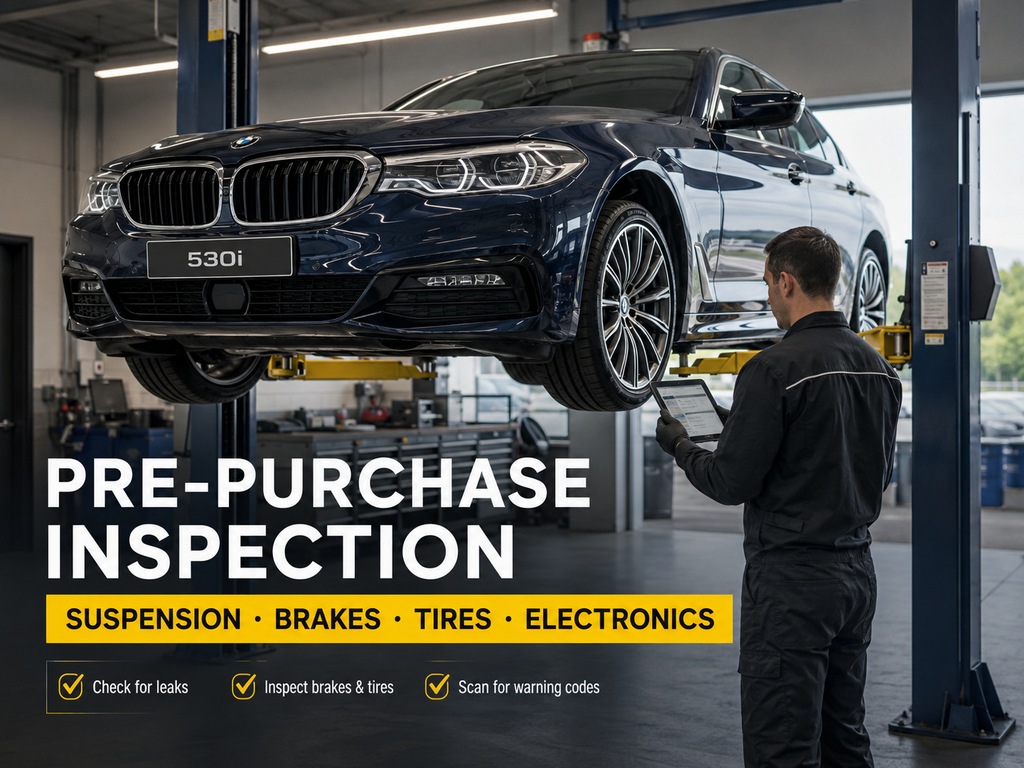
That is why a lift inspection is extremely valuable before buying a used German luxury car.
5. Brake Costs Can Add Up Quickly
The 530i is not an exotic performance car, but BMW brake parts are still more expensive than those on many mainstream vehicles.
Before buying, inspect both the brake pads and rotors.
Do not only look at how much pad material remains.
BMWs frequently need rotors replaced along with the pads when the rotors are worn.
Current U.S. estimates for brake pad replacement alone on many G30 530i model years are roughly $700–$770, before additional rotor replacement is considered.
If all four tires and brakes are approaching the end of their life, your “great deal” can suddenly require several thousand dollars in maintenance.
6. Tires Matter More Than Many Buyers Think
The G30 is sensitive to tire quality.
Cheap tires, mismatched tires, worn tires, or incorrect tire pressure can significantly affect:
Ride comfort
Road noise
Steering feel
High-speed stability
Braking performance
On xDrive models, tire condition deserves even more attention.
Ideally, all four tires should be the same model with similar tread depth.
Look at the DOT date code as well.
A car with low mileage may still have old tires that need replacement simply because of age.
7. Electronics and Battery Condition
The G30 has a large number of electronic systems.
A weak battery can sometimes create multiple warning messages that appear far more serious than the actual problem.
During your inspection, test everything.
Check:
iDrive screen
Navigation
Backup camera
Parking sensors
Power seats
Heated and ventilated seats, if equipped
Climate control
Power trunk
Keyless entry
Driver-assistance systems
Digital instrument cluster
Sunroof
Do not assume a warning message is “just a sensor.”
Scan the vehicle for stored fault codes before purchase.
8. Check for Vibration at Highway Speed
A G30 530i should feel extremely stable on the highway.
If you feel steering-wheel vibration around 50–80 mph, investigate it before buying.
Possible causes include:
Wheel imbalance
Bent wheels
Tire problems
Worn suspension bushings
Alignment issues
BMW wheels with low-profile tires can be damaged by potholes.
A vibration that seems minor during a short test drive can become very annoying during long-distance ownership.
9. Check the ZF 8-Speed Transmission
The ZF 8-speed automatic transmission used in the G30 is generally a strong unit.
A healthy car should shift smoothly in normal driving.
During the test drive, check for:
Harsh engagement into Drive or Reverse
Delayed engagement
Strong jerking between gears
Unusual vibration
Transmission warning messages
Do not judge the transmission only during aggressive acceleration.
Drive slowly through parking-lot speeds and light throttle as well.
Low-speed behavior can reveal issues that are difficult to notice during highway driving.
10. Maintenance History Is More Important Than Mileage
When buying a used BMW, service history is extremely valuable.
Ask for records showing:
Engine oil changes
Brake fluid service
Spark plug replacement
Coolant-related repairs
Battery replacement
Brake work
Suspension repairs
Tire replacement
A car with complete records gives you a much clearer picture of what you are buying.
Be cautious with a vehicle that has changed owners several times and has almost no maintenance documentation.
Estimated BMW G30 530i Repair Costs
Here is a rough guide to several common maintenance and repair items in the U.S.
Repair or Maintenance Item
Approximate Cost
Water pump replacement
$800–$1,050
Thermostat replacement
$900–$1,300+
Valve cover gasket
$700–$1,500
Engine mounts
$400–$800+
Brake pads
$700–$770
Suspension repairs
Varies significantly
Battery replacement
Varies by battery and programming
These numbers are only guidelines.
Dealer labor rates can be considerably higher than independent BMW specialist shops.
Location also makes a major difference.
The important lesson is simple:
Do not spend your entire budget on the purchase price.
How Much Money Should You Keep for Repairs?
If you are buying an older G30 530i without a warranty, keeping an additional repair reserve is a smart idea.
For many buyers, setting aside around $1,500–$3,000 after purchase provides a reasonable starting cushion for unexpected maintenance.
You may not need it immediately.
But having that reserve makes BMW ownership much less stressful.
A used luxury car becomes frustrating when the buyer can afford the purchase price but cannot comfortably afford the maintenance.
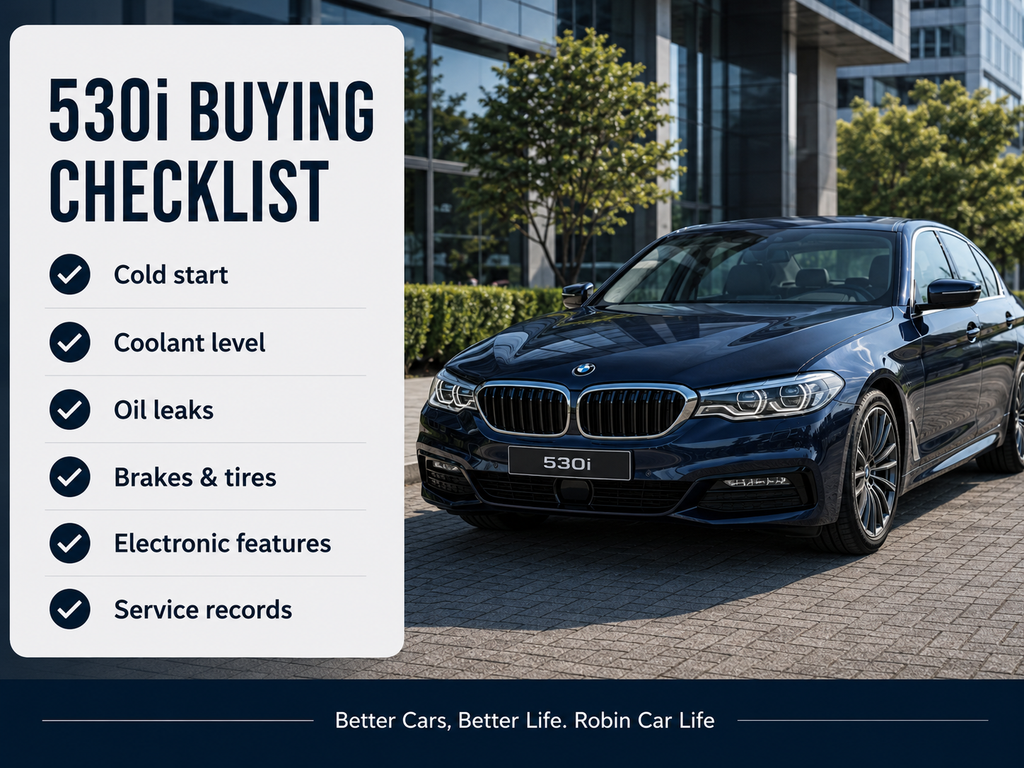
Used BMW 530i Pre-Purchase Checklist
Before buying, try to inspect the vehicle when the engine is completely cold.
Engine
Start the engine cold
Listen for unusual noises
Check idle quality
Look for oil leaks
Check coolant level
Look for dried coolant residue
Transmission
Shift from Park to Reverse
Shift from Reverse to Drive
Check for delays or strong shocks
Test low-speed shifts
Test highway acceleration
Suspension
Drive over small bumps
Listen for knocking noises
Check steering vibration
Inspect control arms and bushings on a lift
Brakes and Tires
Check brake pad thickness
Inspect rotor condition
Check tire tread depth
Check tire age
Look for uneven wear
Check whether all four tires match
Electronics
Test every button
Check cameras and parking sensors
Scan for diagnostic trouble codes
Verify that no warning lights remain on
Vehicle History
Review accident history
Review maintenance records
Verify mileage
Check open recalls by VIN
Have the car inspected by an independent BMW specialist
Should You Buy a Used BMW G30 530i?
For the right buyer, the answer is yes.
The G30 530i remains one of the best-balanced modern BMW sedans.
It is comfortable enough for long highway trips, efficient enough for daily commuting, and still enjoyable to drive.
The B48 four-cylinder also avoids some of the additional complexity and operating costs associated with more powerful models.
But there is one important rule.
Buy the condition, not just the price.
A cheap 530i with neglected maintenance can become very expensive.
A slightly more expensive car with excellent service history, good tires, healthy brakes, no leaks, and a clean inspection can be the much better deal.
Before buying, spend the money on a professional pre-purchase inspection.
It may be the cheapest BMW repair you ever pay for.